Agents and Runtimes
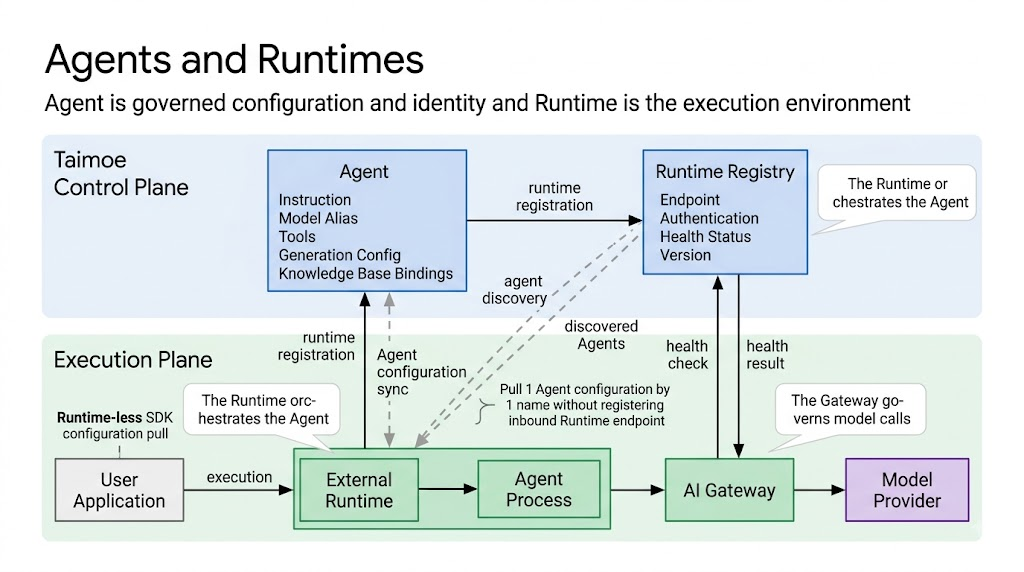
An Agent is a governed configuration and identity. A Runtime is an execution environment capable of running one or more Agents. Keeping them separate lets the platform manage configuration without pretending that the console itself owns every execution process.
Agent
An Agent belongs to a Team and records configuration such as its instruction, model alias, tools, generation parameters, limits, and Knowledge Base bindings. It can optionally reference a Runtime and the identifier used by that Runtime.
Agent instruction changes have append-only history. The platform can therefore show how a managed instruction evolved without rewriting prior versions.
Runtime
A Runtime records an external execution endpoint, environment, owner, authentication method, discovery paths, reported version, and health state. Health checks retain status, latency, response, and error details.
The Runtime is not a model Provider. A typical call path is:
User application -> Agent Runtime -> AI Gateway -> Model Provider
The Runtime performs Agent orchestration. The Gateway governs model calls made during that execution.
Runtime-bound integration
For a server that can expose the Taimoe Runtime contract, the platform can:
- register its base URL and authentication method;
- inspect its well-known and Agent discovery endpoints;
- import selected Agent definitions;
- poll health and show the latest status;
- allow an SDK-enabled Runtime to pull managed Agent configuration.
Discovery does not continuously overwrite console-managed Agents. Import conflicts are skipped unless an explicit force operation is used.
Runtime-less integration
The Python SDK can also consume a platform Agent configuration by name without registering a Runtime endpoint. This is useful for local tools, adk web, and applications that cannot accept inbound discovery calls.
In this mode the platform is the configuration source of truth, but the application still chooses which fields are dynamic. A value hard-coded in application code cannot be changed by the console merely because an Agent resource exists.
Current limitations
Runtime registration, discovery/import, health information, Agent configuration, and SDK pull patterns are available. Cross-Runtime orchestration, marketplace templates, and generic external-Agent proxy modes are planned and are not current contracts.